OVERVIEW

ENERGY EFFICIENCY

OTHER SUSTAINABILITY FEATURES & MEASURES

DRAWINGS

MORE CASE STUDIES

ABOUT THE 2030 CHALLENGE


Building Type:
Post-secondary,
Trades College

Owner:
Okanagan College

Location:
Penticton, British Columbia

Budget: $27,600,000

Completion: June 2011

PROJECT TEAM

Architect:

CEI Architecture

Sustainability Consultant:

Recollective Consulting

Structural Engineer:

Fast + Epp Structural Engineers

Electrical Engineer:

Applied Engineering Solutions

Mechanical Engineer:

AME Consulting Group Ltd.

Civil Engineer:

True Consulting

Quantity Surveyor:

Spiegel Skillen & Associates

Geotechnical Engineer:

Interior Testing Services Ltd.

Landscape Architect:

Site 360 Consulting Ltd.

Construction Manager:

PCL Constructors Westcoast Inc.

Building Code Consultant:

GHL Consultants Ltd.

Acoustic Consultant:

BKL Consultants Ltd.

Envelope Consultant:

Morrison Hershfield

Commissioning Authority:

Inland Technical Services

Jim Pattison Centre of Excellence in Sustainable Building Technologies and Renewable Energy Conservation

CEI Architecture

ENERGY EFFICIENCY


Heating, Cooling & Ventilation

PHOTOS: Ed White
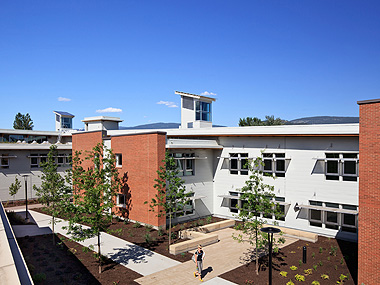
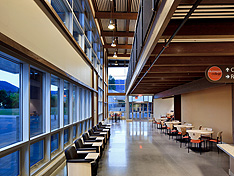
  • The heavily articulated plan allows both daylight and natural ventilation to penetrate deep into the building.
  • A series of five 14-metre high ventilation chimneys along the spine of the building use the natural stack effect of warm buoyant air to draw air through the building. Each chimney has a natural flow rate of 1000 l/s at peak conditions.
  • Glazed panels on the south side of each chimney use solar gain to boost the stack effect, further enhancing the flow rate.
  • All windows are manually operated. A system of simple red/green lights indicate to building occupants when the windows should be opened or closed to maximize heating and cooling.
  • Radiant heating from in-slab PEX piping provides the space heating throughout most of the building.
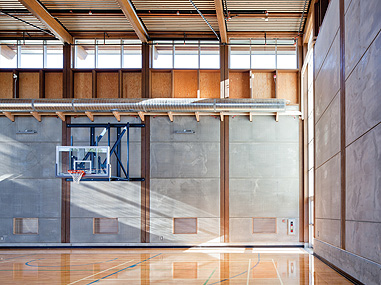
  • Additionally, in the gymnasium, a pioneering system of pre-fabricated concrete-glulam composite wall panels contain radiant heating and cooling systems, improving spatial heating efficiency.
  • Vacuum tube solar panels heat hot water to meet the building’s hot water needs, and to assist the radiant heating. Two alternate forms of solar panel technology are used for study comparison purposes.


Building Envelope

PHOTO: Ed White

Walls: Insulation value of R28
Curtain walls for optimum energy conservation

Roof: Insulation value of R30

Maximum air leakage for building envelope: 5m3/hr/m2

Windows: Triple-glazed and argon-filled

All entrance doors have vestibules

Solar Shading, Daylight & Lighting

PHOTO: Ed White
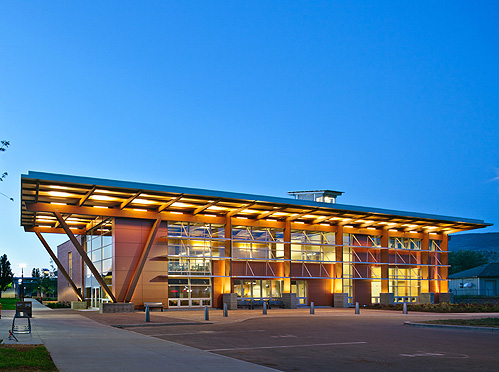
  • All occupied work spaces in the building are within 9 metres of a window offering daylight, views and natural ventilation.
  • A conventional brise soleil controls light falling on the south-facing glazing. Internal high-level opaque glass light shelves bounce the light off the ceiling further into the room.
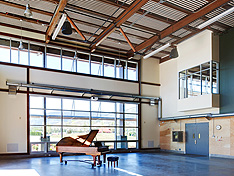
  • High clerestory windows throw light into the larger volumes of the gymnasium and workshops.
  • Vertical light pipes illuminate deep plan spaces such as washrooms, store rooms and parts of the workshops.
  • A prototype sun-tracking system is being trialed in some areas of the building. The system actively tracks and collects sunlight, condensing and redirecting it through proprietary ducts to illuminate spaces deep in the building.
  • All lighting fixtures are high efficiency, with occupancy and daylight sensors. Many fittings use LED light sources.
PHOTO: Ed White