OVERVIEW

ENERGY EFFICIENCY

OTHER SUSTAINABILITY FEATURES & MEASURES

DRAWINGS

MORE CASE STUDIES

ABOUT THE 2030 CHALLENGE


Building Type:
Educational Services / College

Owner:
Algonquin College

Location:
Ottawa, Ontario

Budget: $65,000,000

Completion: August 2011

PROJECT TEAM

Architect:

Diamond Schmitt Architects / Edward J. Cuhaci and Associates Architects Inc.

Design Builder:

Ellis Don

Structural Engineer:

Halsall Associates Ltd.

Mechanical / Electrical Engineer:

Goodkey Weedmark & Associates Ltd.

Landscape Architect:

Gino J. Aiello Landscape Architect

LEED Consultant:

Halsall Associates Ltd.

Commissioning Agent:

Nova Commissioning Services Ltd.

Civil Engineer:

Delcan Corporation

Life Safety Code Consultant:

LMDG Code Consultants

Specification Writer:

Brian Ballantyne Specifications

Acoustic Engineer:

Aercoustics Engineering Ltd.

Geotechnical Engineer:

Alston Associates Inc.

Algonquin Centre for Construction Excellence

Diamond Schmitt Architects /
Edward J. Cuhaci and Associates Architects Inc.

ENERGY EFFICIENCY


Heating, Cooling & Ventilation

PHOTO: TOM ARBAN
  • The building is designed to use less than a third of the energy in operation as compared to a similar building constructed to Code.
  • The heating and cooling system is decoupled from the ventilation system, preventing wasted energy due to over-ventilation and diminished environmental quality due to under-ventilation.
  • Heating and cooling are delivered primarily through a hybrid hydronic heat pump system. Hybrid heat pumps are able to take the advantages of a distributed heat pump system in cooling mode as well as the advantages of fan coils in heating mode, yielding higher seasonal efficiency as compared to either system on its own.
  • An independent CO2 sensor controlled ventilation system (served by a make-up air unit with heat recovery) delivers outdoor air as required to maintain healthy levels, independent of the need for heating or cooling. When CO2 levels are elevated, CO2 sensors cause variable air volume boxes to open, and allow more outdoor air to be delivered.
  • Process loads have also been carefully designed for performance. One such innovative feature includes a system that filters and re-circulates exhaust air in the shop spaces.
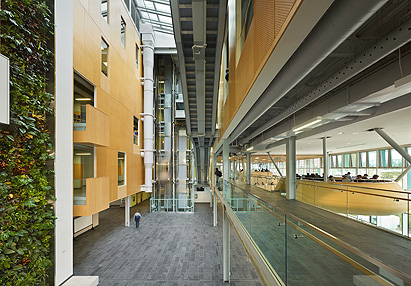
  • The bio-filter wall is a focus of the atrium and plays an active role in the air system, filtering undesirable VOCs & CO2. A return bypass is provided to allow regeneration or servicing of the bio-wall, as well as the management of humidification.

Building Envelope

PHOTO: TOM ARBAN

Roof – R-48 to R-53:

  • A green roof covers 57% of the roof surface.
  • Vegetative areas, planted with sedum in self-irrigating felts, are organized into courtyards, each with a dominant species. The southern-most courtyard contains all the species together as a climax forest and site-specific eco-system.
  • The roof assembly uses approximately 8'' of polyisocyanurate insulation at various depths.
  • Non-vegetated surfaces (rooftop and at grade) are covered with highly reflective materials to further decrease the heat-island effect. These include light-coloured concrete and concrete pavers with an SRI of greater than 29.

Wall – R-27 to R-41 (assembly):

  • Wall type 1: insulated metal panels with 4 inches of R-7.7/inch insulation (long term R-value)
  • Wall type 2: brick walls with 4 inches of sprayed form insulation.
  • Both have minimal thermal bridging.

Foundation floors with radiant heating and exposed floors have 2 inches of extruded polystyrene insulation under the slab.

The windows and skylights are triple glazed and were selected with maximum visible light transmittance and thermal performance (Centre of glass U-value = 0.13).


Solar Shading, Daylight & Lighting

PHOTOs: TOM ARBAN
  • Circular skylights over the trade training spaces provide natural light.
  • Interior windows in the office tower face the atrium to allow natural light to penetrate interior spaces.
  • Punched windows provide daylight to the perimeter. Vertical fins on the east, south and west elevations and an overhang on the north side reduce glare and solar loads while maintaining appropriate daylight conditions. The windows are placed in such a way that they optimize daylight and energy (with minimal glazing to control envelope losses).
  • Photo-sensors automatically dim artificial light.
  • Highly efficient LED and compact fluorescent lighting fixtures are used.