OVERVIEW

ENERGY EFFICIENCY

OTHER SUSTAINABILITY FEATURES & MEASURES

DRAWINGS

MORE CASE STUDIES

ABOUT THE 2030 CHALLENGE


Building Type:
Educational Services / College

Owner:
Algonquin College

Location:
Ottawa, Ontario

Budget: $65,000,000

Completion: August 2011

PROJECT TEAM

Architect:

Diamond Schmitt Architects / Edward J. Cuhaci and Associates Architects Inc.

Design Builder:

Ellis Don

Structural Engineer:

Halsall Associates Ltd.

Mechanical / Electrical Engineer:

Goodkey Weedmark & Associates Ltd.

Landscape Architect:

Gino J. Aiello Landscape Architect

LEED Consultant:

Halsall Associates Ltd.

Commissioning Agent:

Nova Commissioning Services Ltd.

Civil Engineer:

Delcan Corporation

Life Safety Code Consultant:

LMDG Code Consultants

Specification Writer:

Brian Ballantyne Specifications

Acoustic Engineer:

Aercoustics Engineering Ltd.

Geotechnical Engineer:

Alston Associates Inc.

Algonquin Centre for Construction Excellence

Diamond Schmitt Architects /
Edward J. Cuhaci and Associates Architects Inc.

OVERVIEW

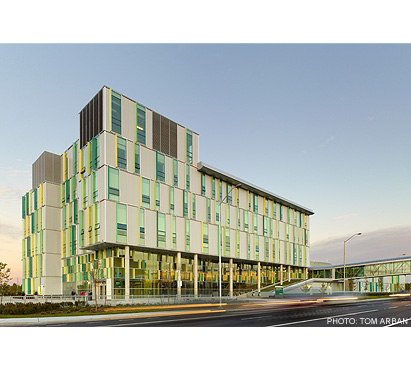
The LEED Platinum Registered Algonquin Centre for Construction Excellence (ACCE) explores innovative new environments in skilled trades education. The 195,000 square-foot building employs rigorous structure, extremely efficient planning, ample natural light and generous public spaces to create new opportunities for synergy between students of skilled trades and technology. The building is planned around social spaces that encourage interdisciplinary interaction. The great hall, with two study pods floating overhead, welcomes the visitor. Balconies and windows overlook the atrium, affording cross and diagonal views to different spaces and activities. The 250-seat café concourse is strategically located on the second floor as a hub and crossroads for students arriving from the east campus by footbridge.

The design for ACCE blends building and landscape. The plazas, garden spaces, undulating green roof, and bio-filter wall form a single system of connected outdoor and indoor spaces. Each element enriches student experience; enhances biodiversity; and uses natural processes to reduce storm water run-off, reduce energy consumption, mitigate urban heat islands and cleanse the indoor air. This 6,000 m2 vegetative “ribbon” also acts as a unifying element: It brings together teaching environments, making a formal elision between low and tall building forms.

While the landscape ribbon defines the Centre’s profile, line and colour unify its edges. Vertically proportioned storey-high metal panels and windows order the elevations. The walls are enlivened by solar sunshades that incorporate five distinct greens, each a variant on the College’s own colour scheme.

The building is designed to act as a “living laboratory”. Exposed structure, ductwork, plumbing, piping, electrical services and lighting, together with wall and floor assemblies, are revealed in place, as well as in ‘cut-away’ sections. The living laboratory features are experienced as central to the design concept, not just as peripheral elements. Daily use of the study spaces, pods, café, stairs, terraces, and atrium will expose students to sustainable practices and materials in use, in an informal but didactic environment. The structural, environmental and energy performance of the building is monitored and displayed on LCD screens, allowing students and the public to understand the invisible forces and processes at work in this precisely tuned instrument of technical and skilled trades education.
 

Energy Conservation Features


Other Sustainability Features


Drawings

 
71% ESTIMATED
REDUCTION IN
ENERGY USE
National Average Energy Use
Intensity (EUI):
1,696 MJ/m2 (471 ekWh/m2)
Building's EUI:
500 MJ/m2
(139 ekWh/m2)
  green roof
The green roof which covers 57% of the roof surface is planted with sedum in self-irrigating felts and organized into courtyards, each with a dominant species. The southern-most courtyard contains all the species together as a climax forest and site-specific eco-system.
[ CLICK FOR Building Envelope ]
 
  vertical sunshades
Vertical fins on the east, south and west elevations and an overhang on the north side reduce glare and solar loads while maintaining appropriate daylight conditions.
[ CLICK FOR details ]
 
  bio-filter wall
The bio-filter wall is a focus of the atrium and plays an active role in the air system, filtering undesirable VOCs & CO2.
[ CLICK FOR Heating, Cooling & Ventilation ]
 
  real-time data
The structural, environmental and energy performance of the building is monitored and displayed on LCD screens, allowing students and the public to understand the invisible forces and processes at work in this precisely tuned instrument of technical and skilled trades education.
[ CLICK FOR Other Features & Measures ]
 
  Natural light
Interior windows in the office tower face the atrium to allow natural light to penetrate interior spaces.
[ CLICK FOR Solar Shading, Daylight & Lighting ]
 
  WATER CONSERVATION
Water for non-potable uses is drawn from nearby ponds further reducing use of potable city water.
[ CLICK FOR DETAILS ]
 
Annual Energy Consumption – Energy Use Intensity (EUI)


Energy Cost

Compared to MNECB energy model


Water Consumption

52% reduction in potable water use (over the LEED baseline) as a result of the rainwater collection cistern system. 100% of all irrigation is reclaimed rainwater.