OVERVIEW

ENERGY EFFICIENCY

OTHER SUSTAINABILITY FEATURES & MEASURES

DRAWINGS

MORE CASE STUDIES

ABOUT THE 2030 CHALLENGE


Building Type:
Higher education facility

Owner:
Simon Fraser University

Location:
8888 University Drive, Burnaby, BC

Construction Cost:

Saywell Hall (Phase 1):
$34.5 million CAD
7,730 SM (83,205 SF)

Blusson Hall (Phase 2):
$46 million CAD
11,400 SM (120,000 SF)

Completion: July 2007

PROJECT TEAM

Architect:

Perkins+Will Canada
P. Busby, D. Dove,
S. Ockwell, H. Kao, B. Greig, Z Smith, J. Loewen

Structural Engineer:

Fast & Epp

Mechanical Engineer and Traffic:

Stantec Engineering

Electrical Engineer:

Acumen Engineering

Landscape Engineer:

Phillips Earevaag Smallenberg

Code:

LMDG Building Code Consultants Ltd.

Cost and Quantity Surveyor:

BTY Group

Building Envelop:

BC Building Sciences Partnership

Programming:

RPG Resource Planning Group

Arts and Social Sciences Complex – SFU

Perkins+Will Canada

OTHER SUSTAINABILITY FEATURES & MEASURES


Products & Materials

PHOTO: NIC LEHOUX

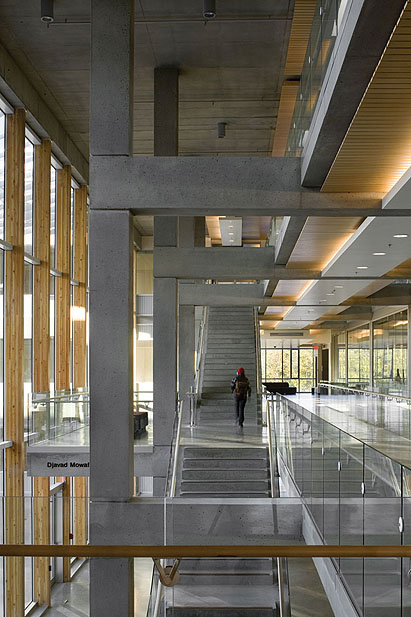
The materials throughout the complex were chosen for their beauty, durability and sustainable properties.

  • The exposed architectural concrete substitutes fly ash for 30-50% of the cement, thereby reducing the energy needed to make concrete and diverting a waste product from landfills.
  • Fritted glass allows daylight through while reducing solar heat gain year round.
  • Glulam window backup is made from locally sourced FSC-certified wood.
  • Low- or no-VOC materials are used throughout the complex in order to improve indoor air quality.
  • In place of wood for exterior applications, the design team chose Prodema, a long-lasting, weatherproof, exterior cladding product made entirely from wood and forestry by-products.

Water Conservation

PHOTO: Perkins+Will Canada
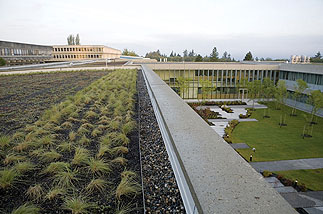
  • 90% of the project has a green roof or is landscaped, and an expansive green wall is located at the south entry of Blusson Hall. These plants and soils absorb rainfall and release it slowly back into the environment.
  • The green roofs also contribute significantly to storm water management.
  • Storm runoff is stored in a 19,000 gallon cistern buried under the courtyard, providing irrigation water during the dry summer months.
  • Low flow fixtures and low water demand landscaping also help reduce water use.


Other Features & Measures

PHOTO: NIC LEHOUX

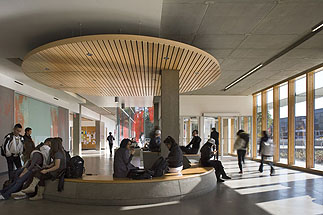
Above all, the project strives to recapture Erickson Massey’s original vision for the campus and update it with new materials and modern methods.

  • The complex follows the original plan’s strong east-west orientation that runs along the spine of Burnaby mountain, which allows for a passive energy design strategy and for building occupants to enjoy the magnificent views.
  • The repetitive vertical elements seen in the original buildings are updated as exterior sunshades that respond to the individual facade’s solar orientation
  • The use of wood in public circulation and gathering areas is protected from deterioration due to exposure.