OVERVIEW

ENERGY EFFICIENCY

OTHER SUSTAINABILITY FEATURES & MEASURES

DRAWINGS

MORE CASE STUDIES

ABOUT THE 2030 CHALLENGE


Building Type:
Community Recreation Centre

Owner:
District Of West Vancouver

Location:
West Vancouver,
British Columbia

Budget: $4,650,000
24 000 sq ft (2230 m2)

Completion: March 2003

PROJECT TEAM

Architect:

Patkau Architects

Landscape Architect:

Vaughan Landscape Planning & Design

Structural Engineer:

Fast & Epp Structural Engineers

Mechanical/Electrical Engineer:

Earth Tech Canada Inc

Civil Engineer:

Webster Engineering

Code Consultant:

Gage-Babcock & Associates

Specifications Consultant:

Susan Morris Specifications

Audiovisual Consultant:

Mc Squared System Design Group

Signage Consultant:

Gallop/Varley

Project Manager:

Maurice J. Ouellette

Consulting Contractor:

Country West Construction

Gleneagles Community Centre

Patkau Architects

ENERGY EFFICIENCY


Heating, Cooling & Ventilation

PHOTO: james dow
  • The project employs the Swiss "Batiso" (Batiment Isotherme) constant temperature building concept, combining an optimized building envelope, radiant slab heating and cooling, displacement ventilation, air to air heat recovery and a geothermal heat pump system.
  • Polyethylene pipe (PEX) was cast into the concrete floor slabs and the concrete tilt-up wall panels. Warmed or cooled water is continuously circulated through the embedded piping to maintain concrete surfaces at a set temperature, allowing it to act as a radiant emitter and/or absorber, providing heating and cooling to occupants. Since air is not being used as a medium for interior climate control, opening windows or doors has little effect on the performance of the heating and cooling system.
  • Two ground-source heat pumps are tied to a ground source heat exchanger consisting of 3,000m of “slinky” plastic piping installed below the parking area. The exchanger utilizes the earth’s stable temperature as a heat source, or heat sink, depending on the demand.
  • The ground-source heat pump system has the capacity to meet all building cooling requirements. A gas fired boiler provides domestic hot water needs and is available to supplement the ground source heat pumps during peak heating conditions.
  • Ventilation is accomplished using a displacement system. 100% fresh air is tempered and supplied at low velocity at low levels. This air rises, flushing contaminants upward, where it is captured and exhausted through a heat recovery ventilator.

Building Envelope

PHOTO: james dow

Walls:

  • Insulated double-wythe composite tilt-up concrete walls – R 14.9

Roof:

  • Insulated standing seam metal & heavy timber roof – R 34.5
  • Insulated ‘green roof’ –
    R 30.15 (below growing medium)

Foundation Walls and slab:

  • Insulated foundation walls –
    R 10.4
  • Insulated slab-on-grade –
    R 14.3

Windows and Glazing:

  • Double glazing
  • Low E coating on surface 2 – U-Value 0.25


Solar Shading, Daylight & Lighting

PHOTOs: james dow
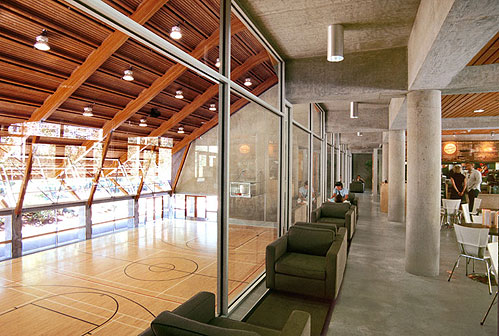
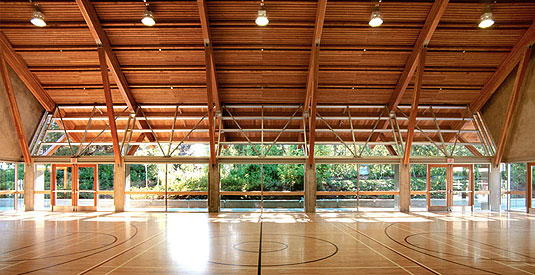
  • Clerestory glazing and skylights provide natural daylight illumination.
  • Artificial lighting is provided by energy efficient compact fluorescent lighting in offices, meeting rooms, lounge and daycare areas.
  • Linear fluorescent luminaires with energy efficient lamps and electronic HPF ballasts in the arts room and outdoor specialty area.
  • Lighting control system in the gymnasium provides for four different illumination levels to address the multi-use nature of the space and to reduce energy consumption.
  • Energy demand is reduced through multiple switching options and occupancy sensors installed in occasional use areas such as washrooms, storage and utility rooms.
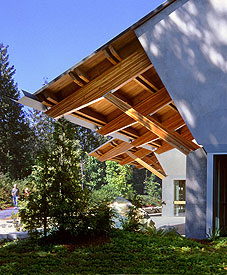
  • Generous roof overhangs shade building interiors from excessive local solar loads in summer.
  • A system of internal manual and motorized blinds provides for additional shading and glare control.