OVERVIEW

ENERGY EFFICIENCY

OTHER SUSTAINABILITY FEATURES & MEASURES

DRAWINGS

MORE CASE STUDIES

ABOUT THE 2030 CHALLENGE


Building Type:
Office/Operations Center

Owner:
Parks Canada

Location:
Sydney, BC
(Vancouver Island)

Budget: $3,240/m2 - 1070m2

Completion: January 2006

PROJECT TEAM

Architect:

McFarland Marceau Architects Ltd.

Structural Engineer:

CWMM Consulting Engineers

Mechanical Engineer:

Stantec Inc.

Electrical Engineer:

Robert Freundlich & Associates Ltd.
(Acquired by Genivar)

Civil Engineer:

1st Team Engineering Ltd.

Energy Consultant:

Enersys Analytics

Building Science Professional:

Read Jones Christoffersen Ltd

Landscape Architect:

Phillips Farevaag Smallenberg

Contractor:

Ledcor Special Projects

Cost Consultant:

James Bush & Associates Ltd.

Environmental Adviser:

Gartner Lee Ltd.
(Acquired by AECOM Technology Corporation)

Commissioning Authority:

BC Buildings Corporation

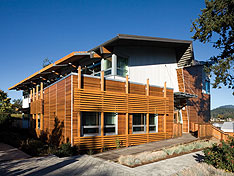
Parks Canada – Gulf Islands Operations Center

McFarland Marceau Architects Ltd.

ENERGY EFFICIENCY


Heating, Cooling & Ventilation

PHOTOs: Derek Lepper
  • Ventilation system consists of a 100% outside air system with high induction diffusers.
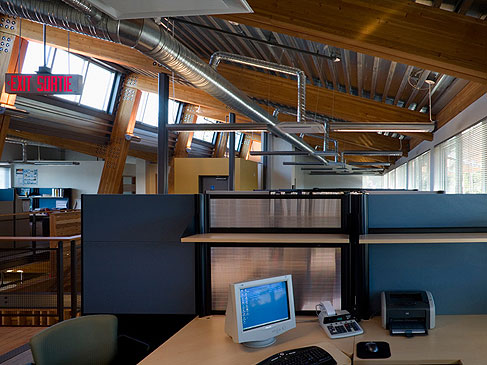
  • Motorized Louvers at high level allow heated air to escape & increase ventilation rates through natural ventilation.
  • Opening windows at all workstations and offices.
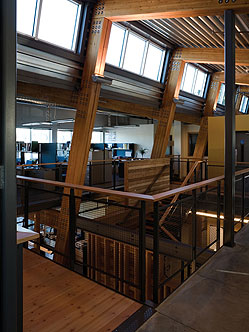
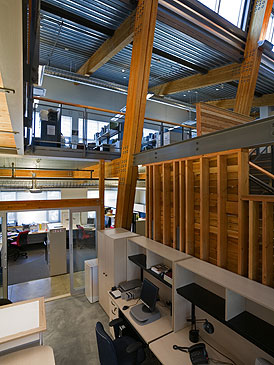
  • The open atrium promotes natural ventilation.
  • Occupancy demand ventilation control including carbon dioxide sensors.
  • Heat from exhaust air is utilized with a heat recovery system to preheat outside air.
  • The sole heat source for the building is the ocean. Ocean water is piped to heat pumps located in the mechanical room, which extract heat from the water.
  • Heat is transferred through a titanium plate heat exchanger to the building heating system and to a domestic hot water tank.
  • The building heating distribution system consists of capillary tubing embedded in the concrete floors.
  • Building Systems are continuously monitored to provide feedback on performance and energy consumption through a DDC system.


Building Envelope

PHOTO: Derek Lepper

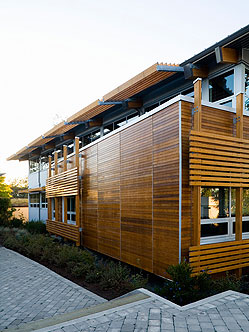
The cladding system was detailed to reduce the overall amount of material needed to support the cladding and to reduce thermal bridging through the assembly. This design helps to reduce heat loss in the winter and mitigates heat gain in the summer. Metal fasteners, cladding and finishes have been selected to meet demands of the marine environment.

Solar Shading, Daylight & Lighting

PHOTOs: Derek Lepper
  • Electrical energy consumption for lighting is greatly reduced by natural light coming in from the north facing windows and clerestory.
  • Energy efficient lighting fixtures were installed to complement the lighting needs of office spaces. Lighting layout and performance of fixtures have helped reduced electrical energy consumption. Over the last five years of the building’s operation, only two bulbs were replaced.
  • Exterior sunshades have been designed to protect interior of building from the south side, by limiting the amount of direct solar radiation to penetrate windows.