OVERVIEW

ENERGY EFFICIENCY

OTHER SUSTAINABILITY FEATURES & MEASURES

DRAWINGS

MORE CASE STUDIES

ABOUT THE 2030 CHALLENGE


Building Type:
Office/Operations Center

Owner:
Parks Canada

Location:
Sydney, BC
(Vancouver Island)

Budget: $3,240/m2 - 1070m2

Completion: January 2006

PROJECT TEAM

Architect:

McFarland Marceau Architects Ltd.

Structural Engineer:

CWMM Consulting Engineers

Mechanical Engineer:

Stantec Inc.

Electrical Engineer:

Robert Freundlich & Associates Ltd.
(Acquired by Genivar)

Civil Engineer:

1st Team Engineering Ltd.

Energy Consultant:

Enersys Analytics

Building Science Professional:

Read Jones Christoffersen Ltd

Landscape Architect:

Phillips Farevaag Smallenberg

Contractor:

Ledcor Special Projects

Cost Consultant:

James Bush & Associates Ltd.

Environmental Adviser:

Gartner Lee Ltd.
(Acquired by AECOM Technology Corporation)

Commissioning Authority:

BC Buildings Corporation

Parks Canada – Gulf Islands Operations Center

McFarland Marceau Architects Ltd.

OTHER SUSTAINABILITY FEATURES & MEASURES


Products & Materials

PHOTO: Derek Lepper

Use of Wood

Durability of materials was a key consideration in the harsh marine environment. Locally harvested wood was chosen as an interior finish to complement the concrete floors and exposed steel deck of the main spaces, and as an exterior finish to contrast with the corrugated metal cladding.

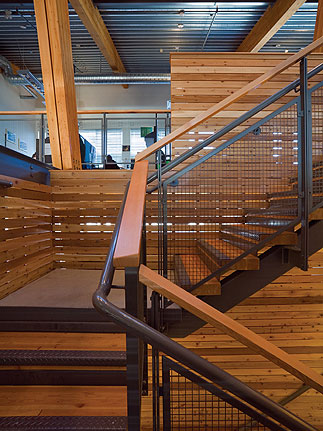
Several interior walls are clad in western red cedar slats, gapped and backed with acoustic insulation to provide sound absorption. Cedar is also used in the open partition, which surrounds the main staircase that rises through the atrium.

Western red cedar was chosen for external use because of its natural resistance to degradation. The sunscreens incorporate a range of standard board sizes while the exterior horizontal cladding is made from custom milled sections.

  • Exterior Sun Shades:
    2x10 STK horizontal WRC members, 2x4 STK WRC vertical members
  • Exterior Cladding:
    1x4 Clear WRC board's custom milled
  • Interior Stair Enclosure:
    1x4 cedar prefinished Grade B slats
  • Interior Acoustic partitions:
    1x2 prefinished Grade B WRC strapping and 1x4 prefinished Grade B WRC siding

Materials have been selected to reflect their structural characteristics with an emphasis on natural finishes. Interior finishes have been kept to a minimum, by designing the exposed structural materials to be the finishes where possible. Concrete floors are left exposed, except within workstations and offices, and exposed steel deck and concrete slab ceilings predominate. Douglas Fir glulams, wood framing members and wall finishes are of local species and have been left exposed.

Adhesives, sealants, paints and finish materials including the carpet, were all selected on the basis of low or no VOC, no other chemical emissions (off-gassing), high durability and low cost.

Recycled content of materials amounts to 31% for the project
(Post-Consumer and ½ Pre-Consumer combined):

  • Fly ash replaces some of the Portland cement in concrete: 84%
  • Steel varies from 25 to 95%
  • Glulam Beams: 25%
  • Thermal Insulation: 51%
  • Acoustic insulation: 35%
  • Millwork panel products: 80%
  • Wood Doors: 75%
  • Carpet Tile: 36%
  • Aluminum Frames: 60%
  • Washroom Accessories varies from 45 to 70%
  • Gypsum Wall Board: 25%
  • Pressed Steel Frames: 63%

Regional materials amount to 20% of building’s materials and include:

  • Concrete & Concrete Blocks;
  • Glulam Beams & Columns;
  • Dimension lumber;
  • Cedar cladding;
  • Interior wood finishes;
  • Millwork.

Construction waste diverted from landfill: 85%


Water Conservation

Rainwater collected from the roofs is directed to a large (30,000 liter) underground storage tank. This water is then used for flushing toilets and as wash water in the marina.

Surplus stormwater flows through a sediment trap and oil separator before being discharged into the ocean. Over 108,000 liters of water is harvested and used annually.

Planting is drought-resistant and has not required any irrigation since it has been established.

Other Features & Measures

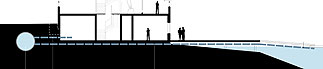
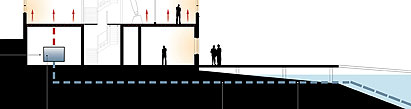
  • The mechanical system, including the radiant slab heating/cooling system coupled with the ocean-based geo-exchange and heat recovery wheel greatly reduces the amount of energy needed to condition the indoor environment.
  • Two titanium ocean loop circulating pumps each work for 168 hours then trade duties. They pump 60 GPM thru one 3” HDPE intake and return line.
  • Four identical water-to-water heat pumps do the work. The 208 volts, 3 phase heat pumps use 17 amps each x 3 at peak (51 amps) but average 34 total amps in normal conditions.
  • On the south facing inclined roof of the building, 42 photovoltaic modules arranged in 6 bays of 7 panels provide for approximately 7% of the energy demand of the building.