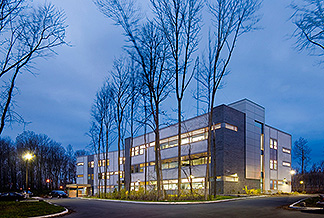
The Hagen Pet Products head office, constructed in 2006, satisfies the 2030 Challenge performance target set for 2005 to 2010. The building envelope was designed to support a low-temperature heating and cooling system that does not use supplementary perimeter heating or cooling. The success of the envelope design can be attributed to reasonable insulation levels and dramatic reductions in the typical office window-to-wall area ratio.
Construction in 2006 referenced the Model National Energy Code of Canada for Buildings 1997 (MNECB), for which Quebec required the highest levels of envelope insulation of the Canadian Provinces. Whole building energy modeling demonstrates that the Quebec MNECB requirements are close to optimum for the purposes of reducing annual energy consumption.
The Hagen roof had a design target RSI of 3.52 (R-20), slightly exceeding the MNECB requirement of RSI 3.45. The ratio of wall area to roof area is 2.7, meaning walls are more important than roofs for heat transfer. The Hagen walls had a design target RSI of 4.84 (R-27.5), significantly exceeding the MNECB requirement of RSI 3.03.
Two principal wall assembly types are used. Brick cavity walls use spray foam insulation on sheathing over steel studs. This assembly slightly outperforms the design value. Precast concrete walls used spray foam on the back of the concrete panels protected by an insulated cavity of steel studs and glass fibre batts. This assembly does not achieve the design value due to thermal bridging through the steel studs, but meets the prescriptive MNECB requirements.
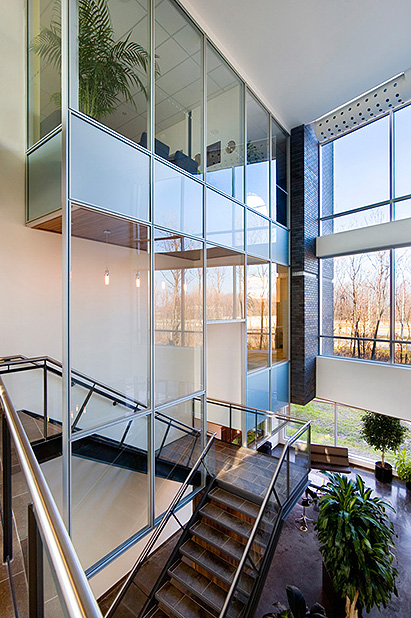
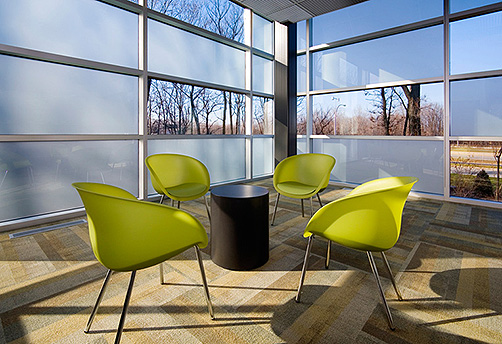
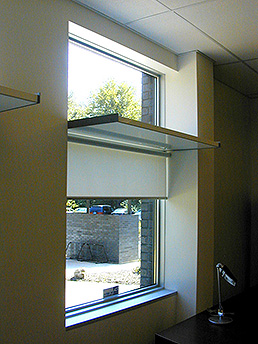
The design strategy for windows separates them by their tasks. Ribbon windows are designed for views to the outside and glazed with low-e coated clear vision glass. Larger daylighting windows with higher window heads are assembled with heat rejecting low-e coatings and blue-green tinted glass.
The dominant contributor to the energy efficiency of the building envelope is the reduction of glazing area across all elevations. The window-to-wall area ratios are as follows: North facades 42.6%; East facades 15.8%; South facades 28.1%; West facades 22.6%. The overall building window-to-wall ratio is 27.3%. Conventional office buildings clad with curtain wall have fenestration areas of over 50%. |