OVERVIEW

ENERGY EFFICIENCY

OTHER SUSTAINABILITY FEATURES & MEASURES

DRAWINGS

MORE CASE STUDIES

ABOUT THE 2030 CHALLENGE


Building Type:
Office and Workshop

Owner:
Toronto and Region Conservation Authority

Location:
Vaughan, Ontario

Budget: $2,800,000

Completion: May 2007

PROJECT TEAM

Architect:

Montgomery Sisam

Santiago Kunzle,
Principal-in-Charge

Geordon Green, MRAIC, Project Manager and Architect

Leslie Parker

Evelyn Casquenette, diagrams

Structural:

Read Jones Christoffersen

Mechanical and Electrical:

Enermodal Engineering

Contractor:

Percon Construction Inc.

Landscape:

Toronto and Region Conservation Authority

Ron Koudys Landscape Architect

Costing:

CM2R

LEED/ CBIP Consultant:

Enermodal Engineering

Site Services:

EMC Group

Specification Consultant:

archiTEXT Consulting

Restoration Services
Centre – Toronto and Region Conservation Authority

Montgomery Sisam

OVERVIEW

The Restoration Services Centre was the first building in Eastern Canada to be certified LEED Platinum. The workshop and office responds to the Toronto and Region Conservation Authority’s mandate to facilitate a broad understanding of integrated approaches to sustainable living.

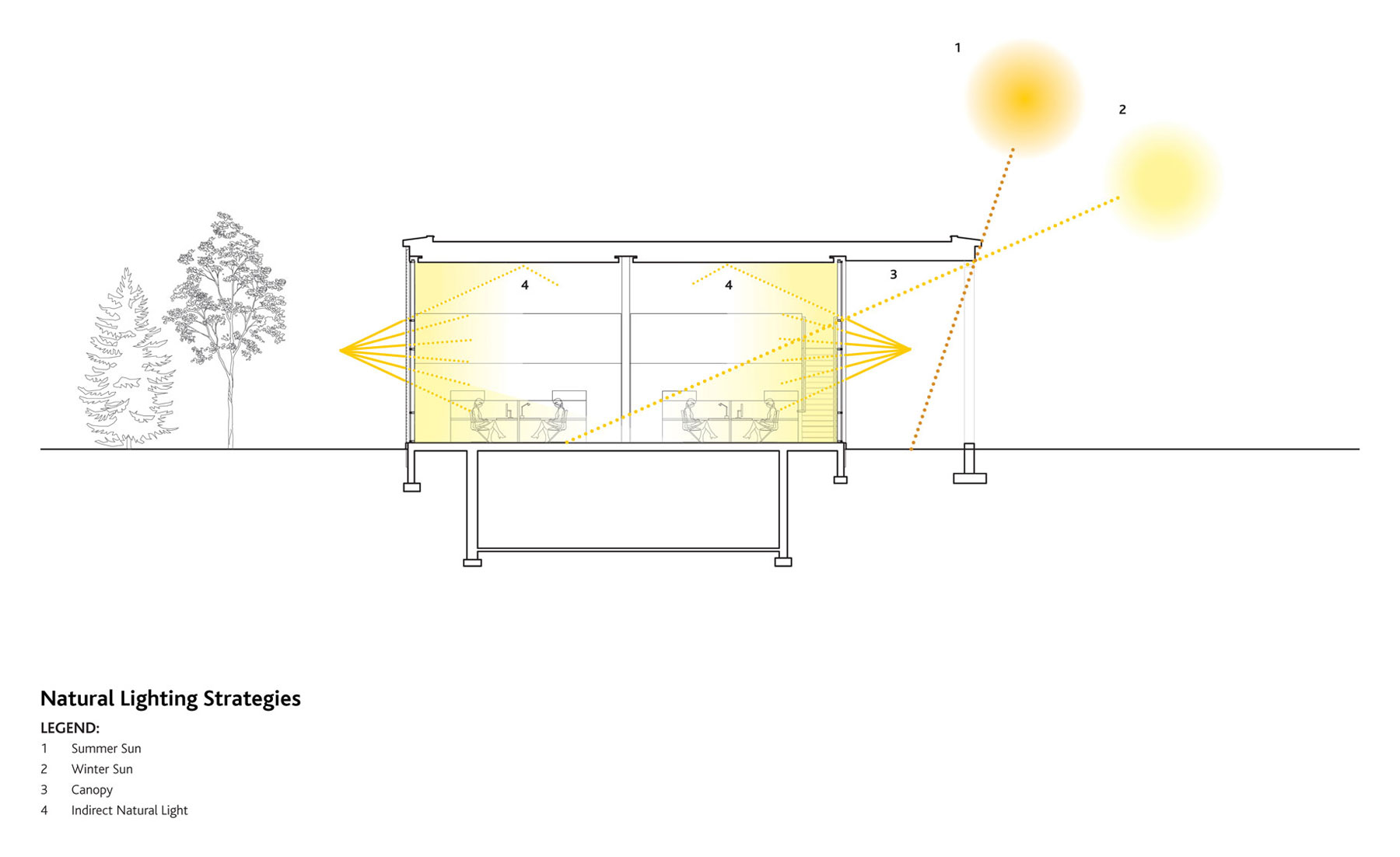
The design focuses on using simple, low-cost solutions to drive high performance sustainability outcomes.  For example, a careful analysis of the site influenced basic design decisions.  The east/west orientation of the building maximizes the benefits of north and south exposures. The deep, south facing porch shields the windows from hot summer sun but allows the winter sun, which is lower in the sky, into the building. Low occupancy areas, such as the workshop and change rooms, were located at the west end of the building to further shelter the office space from excessive heat gain and harsh afternoon summer sun. This, in addition to generous north facing windows and a narrow floor plate, provides for abundant natural light, substantially lowering reliance on artificial lighting and cooling.

Within the main double height space, much of the structure has been left exposed to promote a better understanding of the building’s construction. Through the use of a ground source heat pump, occupancy and photocell sensors for artificial lighting, heat recovery and passive tempering of fresh air, a high level of energy efficiency was achieved. Composting toilets, waterless urinals and ultra low flow faucets and shower heads drastically reduce potable water consumption.
 

Energy Conservation Features


Other Sustainability Features


Drawings

 
61% MEASURED
REDUCTION IN
ENERGY USE
National Average Energy Use
Intensity (EUI):
1,382 MJ/m2 (384 ekWh/m2)
Building's EUI:
543.6 MJ/m2
(151 ekWh/m2)
  SOLAR SHADING
The deep, south facing porch shields the windows from hot summer sun but allows the winter sun, which is lower in the sky, into the building.
[ CLICK FOR COMPLETE DIAGRAM ]
 
  nATURAL LIGHT
Generous north facing windows and a narrow floor plate provide for abundant natural light.
[ CLICK FOR FLOOR PLAN ]
 
  PRODUCTS & MATERIALS
The long brick wall that lines the entryway was constructed of brick salvaged from a demolished older building.
[ CLICK FOR DETAILS ]
 
  WATER CONSERVATION
Water for non-potable uses is drawn from nearby ponds further reducing use of potable city water.
[ CLICK FOR DETAILS ]
 
  WATER CONSERVATION
Water for non-potable uses is drawn from nearby ponds further reducing use of potable city water.
[ CLICK FOR DETAILS ]
 
  WATER CONSERVATION
Water for non-potable uses is drawn from nearby ponds further reducing use of potable city water.
[ CLICK FOR DETAILS ]
 
Annual Energy Consumption – Energy Use Intensity (EUI)


Utility-Specific Reductions

Compared to the estimated values of a baseline building*


Reporting period: July 2007 to June 2008

* Baseline: A building energy simulation developed using the EE4 energy modeling software, representing a building of identical size and function to the actual building but without the energy conserving measures. The baseline simulation represents a building that is designed to meet, but not exceed, the Canadian Model National Energy Code for Buildings.