OVERVIEW

ENERGY EFFICIENCY

OTHER SUSTAINABILITY FEATURES & MEASURES

DRAWINGS

MORE CASE STUDIES

ABOUT THE 2030 CHALLENGE


Building Type:
Education and Research

Owner:
University of Calgary

Location:
Calgary, Alberta

Budget: $23,000,000

Completion: August 2007

PROJECT TEAM

Architect:

Kasian Architecture

Structural Engineer:

Read Jones Christoffersen

Mechanical Engineer:

Wiebe Forest Engineering

Electrical Engineer:

Wiebe Forest Engineering

Energy Consultant:

University of Calgary,
Prof. J. Love

Landscape:

Scatliff Miller Murray Landscape Architects

Contractor:

Ellis Don Construction

Child Development Centre

Kasian Architecture

OVERVIEW

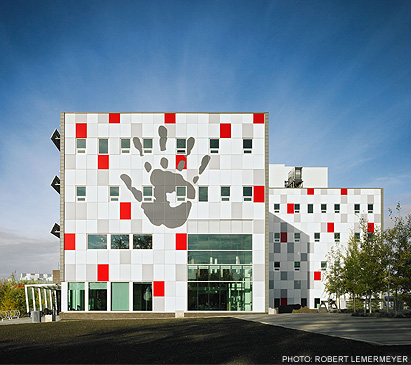
The Child Development Centre (CDC) was conceived to bring together specialists in services for special needs children, including university researchers, medical staff, psychologists and social workers. The main level includes a daycare for 80 children of university staff and students as well as a school for special needs children.

In 2004, the University of Calgary set a target of LEED platinum for new university buildings. The CDC was the first building constructed under this policy. The energy strategy focused on minimizing energy use, especially electricity use, since a large fraction of Alberta electricity is generated in coal-fired plants. For example, the overall window-to-wall ratio is around 21%, compared with the prescriptive limit of 26% for Calgary in the 2011 National Energy Code for Buildings. The low envelope gains and losses (fixed exterior shades reduce solar gain) combined with low interior gains allow the use of a low-flow ventilation system.

A special feature of the project is the photovoltaic system, which is incorporated into the shading system. During construction, the University made targeted funds available for the system.

While the campus has a district energy system, the CDC site was west of the tunnel network and extension of the network was beyond the scope and budget of the project.

Another challenge to the energy efficiency of the project was the high construction inflation of about 2% per month in Calgary. This made triple-glazing prohibitively expensive, so the windows are at the low end of performance for metal frame windows.

The monitored energy use shows that very low energy use can be achieved with envelope heat transfer much higher than the prescriptive limits in the 2011 National Energy Code for Buildings. For example, the US National Renewable Energy Laboratory's 20,000 m2 net-zero Research Support Facility in Golden, CO, with a heating requirement about 20% lower than Calgary, has an energy intensity of only 20% less than that of the CDC.
 

Energy Conservation Features


Other Sustainability Features


Drawings

 
77% MEASURED
REDUCTION IN
ENERGY USE
National Average Energy Use
Intensity (EUI):
2,212 MJ/m2 (614 ekWh/m2)
Building's EUI:
514 MJ/m2
(143 ekWh/m2)
  low envelope gains and losses
The overall window-to-wall ratio is around 21%, compared with the prescriptive limit of 26% for Calgary in the 2011 National Energy Code for Buildings.
[ CLICK FOR Building Envelope ]
 
  dual-purpose Panels
The photovoltaic panels, which generate about 10% of electricity use, also serve as a shading system that helps reduce solar gain.
[ CLICK FOR Other Features & Measures ]
 
  Heating, Cooling & Ventilation
Because a high fraction of outdoor air is supplied to the classrooms and day care rooms, the main level has a dedicated air handler with heat wheel enthalpy recovery.
[ CLICK FOR details ]
 
  Solar Shading, Daylight & Lighting
The Z configuration provides more exterior area in the west and east "extensions" (daycare and multipurpose space), and daylight-responsive controls are used.
[ CLICK FOR DETAILS ]
 
  WATER CONSERVATION
Water for non-potable uses is drawn from nearby ponds further reducing use of potable city water.
[ CLICK FOR DETAILS ]
 
  WATER CONSERVATION
Water for non-potable uses is drawn from nearby ponds further reducing use of potable city water.
[ CLICK FOR DETAILS ]
 
Annual Energy Consumption – Energy Use Intensity (EUI)

Reporting period: Jan. 1, 2011 to Dec. 31, 2011


Energy Cost Reductions

The LEED (simulated) energy cost reduction was equivalent to about $200,000 per annum at the time the building was certified in 2008. The building was simulated with EE4-DOE2.