OVERVIEW

ENERGY EFFICIENCY

OTHER SUSTAINABILITY FEATURES & MEASURES

DRAWINGS

MORE CASE STUDIES

ABOUT THE 2030 CHALLENGE


Building Type:
Warehouse converted to architect’s office

Owner:
Busby Perkins+Will

Location:
1220 Homer Street, Vancouver, BC

Budget: $1,100,000

Completion:
Original – 1946
Rehabilitation – 2000

PROJECT TEAM

Architect:

Busby Perkins+Will
P. Busby, D. Dove, S. Gushe, S. Ockwell

Designlines Ltd.
S. Schou

Structural Engineer:

Glotman Simpson

Skylight:

Fast & Epp

Electrical Engineer:

Flagel Lewandowski
(now Acumen Engineering)

Mechanical Engineer:

Keen Engineering

1220 Homer Street

Busby Perkins+Will / Designlines Ltd.

ENERGY EFFICIENCY


Heating, Cooling & Ventilation

PHOTO: Busby Perkins+Will

Stack Effect:

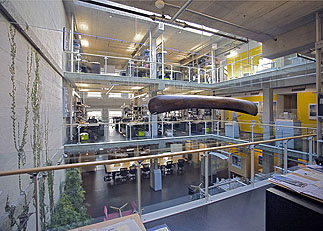
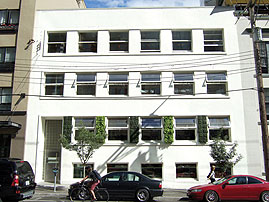
During the renovation in 2000, operable windows were installed at the east and west elevations and an atrium was cut through the centre of the building to allow for daylight penetration and stack effect natural ventilation. The ‘stack effect’ is caused by the natural tendency of hot air to rise and cool air to sink. Connecting floors with atria, shafts, and stairwells can take advantage of this natural behaviour to move air and heat around a building. These connecting spaces must be effectively sized, and linked to operable windows to function as ventilators that are able to naturally provide fresh air and remove stale air from a building.

1220 Homer Street's operable windows and skylight are connected to thermal sensors in the occupied areas of the building. As the internal air temperature rises in summer, the atrium glazing opens to exhaust warm air. The perimeter glazing opens to let in fresh air when the temperature reaches 23-24 degrees C. A small weather station on the roof includes wind and rain detectors that will close the windows in adverse conditions.

Thermal Mass:

The exposed concrete walls and ceiling provide the benefits of thermal mass. “Thermal mass” means any kind of material that is able to absorb heat slowly, and then release it over a long period of time. It helps to naturally regulate the temperature swings in an environment, as it is able to trap heat when it is hot, and then release the same heat when the surrounding temperature is lower.

Building Envelope

PHOTOS: Busby Perkins+Will

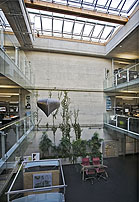
The 1950s warehouse's original single-glazed windows have been updated to double-glazed low-E. The skylight above the atrium is made up of short sections of greenhouse glazing, complete with the gearing and control systems standard to that industry.

The building benefits from the insulation of buildings on the north and south side. Recent upgrades were performed in 2009 to insulate the fourth floor staff kitchen and sample library with an additional R-14 Walltite Eco spray insulation by BASF.


Solar Shading, Daylight & Lighting

PHOTOS: Busby Perkins+Will / Nic Lehoux

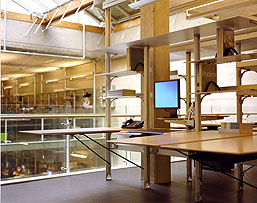
The large, open atrium not only allows the stack effect of natural ventilation to effectively cool-down and provide fresh air to the entire office, it also pours daylight down to the ground floor. Daylight penetrates to every work station from the enormous, yet simple and inexpensively installed skylights at the top of this space.

The occupants are aware of the natural rhythms of the day and seasons as sun and rain moves across the transparent skylights. The rattle of the occasional hail storm causes staff to congregate at the atrium railings in admiration.

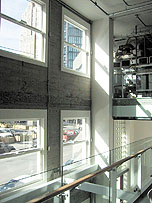
A second cut through the floor plates at the entrance adds to the daylighting of the interior space as well as providing an expansive display area.