OVERVIEW

ENERGY EFFICIENCY

OTHER SUSTAINABILITY FEATURES & MEASURES

DRAWINGS

MORE CASE STUDIES

ABOUT THE 2030 CHALLENGE


Building Type:
Interpretive Centre

Owner:
Cumberland Regional Economic Development Association / Joggins Fossil Institute Association

Location:
Joggins, Cumberland County, Nova Scotia

Budget:
$5,200,000 (1,235m2)

Completion: May 2008

PROJECT TEAM

Architect:

WHW Architects Inc.

John Crace, LEED AP
Partner in Charge/LEED Consultant

Ron Burdock, LEED AP Design/Project Architect

Project Staff:
David Phillips, LEED AP
Ian Miller
Karon Coffin, LEED AP
Lisa Tondino , LEED AP
Jonathan Carmichael

Brian Colgan, LEED AP
Construction Administration

Christine Bales, LEED AP
Sustainable Projects Coordinator

Interpretive Design:

Design + Communication

Landscape:

Vollick McKee Petersmann,
Cary Vollick

Structural:

BMR Structural Engineering,
Roy McBride

Electrical & Mechanical:

O’Neill Scriven & Associates,
Allan MacDonald & Trent Moore

Civil:

ABL Environmental,
Tom Austin

Environmental:

Strum Environmental,
Sean Cassidy

Archaeological Survey:

Davis Archaeological Consultants

Business Plan:

A. L. Arbic Consulting

Cost:

Hanscomb Limited

Fundamental Commissioning:

O’Neill Scriven & Associates, Peter Scriven (not part of Project Design Team)

General Contractor:

Pomerleau

Joggins Fossil Centre

WHW Architects Inc.

ENERGY EFFICIENCY


Heating, Cooling & Ventilation

PHOTO: WHW/Craig Mosher
  • 2 air source pumps condition the building. The heat pumps have a heating and cooling COP of 3.11 and 2.90.
  • Each of the ventilation systems is equipped with a heat recovery ventilator with effectiveness between 0.26 and 0.68.
  • Four flat plate panels pre-heat domestic hot water, resulting in a 36% reduction in the energy demand for that purpose.

Building Envelope

PHOTO: WHW/Craig Mosher

Roof

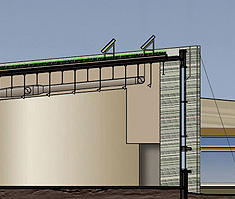
  • 2/3 green living roof – Average R value 34 (RSI 6)

Walls

  • All insulation outboard of sheathing, continuous insulation plane over foundation wall, minimizes thermal bridge. Average R value 25 (RSI 4.4)
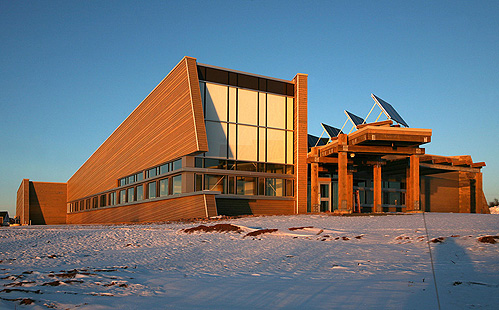
  • Locally quarried stone (<100km from site) and Nova Scotia harvested hemlock used for cladding

Windows

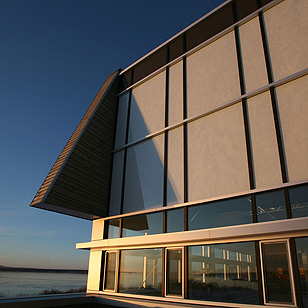
  • Thermally broken aluminum frames; low E, argon- filled sealed units (U 2.63W/m2K) or “Solera T” (U 1.14 w/m2K) glazing units
  • Glazing constitutes 18% of wall area


Solar Shading, Daylight & Lighting

PHOTOs: WHW/Craig Mosher
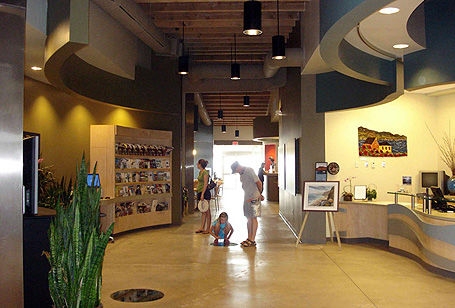
  • The building design provides daylight to 85% of regularly occupied spaces and direct lines of sight to perimeter glazing in 92% of regularly occupied spaces.
  • Interior and exterior artificial lighting designed to reduce light pollution and to preserve a dark sky.
  • Interior lighting designed to ensure maximum candela from each interior luminaire