 |
|
 |
|
| |
Building Type:
Interpretive Centre
Owner:
Cumberland Regional Economic Development Association / Joggins Fossil Institute Association
Location:
Joggins, Cumberland County, Nova Scotia
Budget:
$5,200,000 (1,235m2)
Completion: May 2008
PROJECT TEAM
Architect:
WHW Architects Inc.
John Crace, LEED AP
Partner in Charge/LEED Consultant
Ron Burdock, LEED AP Design/Project Architect
Project Staff:
David Phillips, LEED AP
Ian Miller
Karon Coffin, LEED AP
Lisa Tondino , LEED AP
Jonathan Carmichael
Brian Colgan, LEED AP
Construction Administration
Christine Bales, LEED AP
Sustainable Projects Coordinator
Interpretive Design:
Design + Communication
Landscape:
Vollick McKee Petersmann,
Cary Vollick
Structural:
BMR Structural Engineering,
Roy McBride
Electrical & Mechanical:
O’Neill Scriven & Associates,
Allan MacDonald & Trent Moore
Civil:
ABL Environmental,
Tom Austin
Environmental:
Strum Environmental,
Sean Cassidy
Archaeological Survey:
Davis Archaeological Consultants
Business Plan:
A. L. Arbic Consulting
Cost:
Hanscomb Limited
Fundamental Commissioning:
O’Neill Scriven & Associates, Peter Scriven (not part of Project Design Team)
General Contractor:
Pomerleau |
|
|
|
|
Joggins Fossil Centre
WHW Architects Inc.
OTHER SUSTAINABILITY FEATURES & MEASURES
|
Products & Materials |
| |
 |
|
PHOTO: WHW/Craig Mosher |
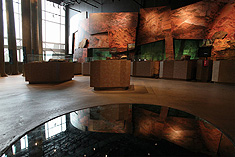
- 19.88% of project materials contained combined post-consumer + pre-consumer recycled content.
- 22.81% of project materials were regionally extracted, processed and manufactured.
- Only Low Emitting Materials were used. The use of low level VOC levels in all adhesives, sealants, paints, coatings and carpet systems was ensured. Composite wood and laminate adhesives did not contain added urea-formaldehyde resins.
- Wherever possible, added finishes were “designed out” of the project, minimizing cost, material use and embodied energy.
|
Water Conservation |
 |
| PHOTO: WHW/Craig Mosher |
- Integrated water reduction measures result in an overall water use reduction of over 77%.
- Water and septic systems are managed onsite.
- The specified dual flush toilets and waterless urinal plumbing fixtures alone can realize a 43% reduction in wastewater. The building has low-flow washroom faucets with a maximum flow rate of 0.5 GPM.
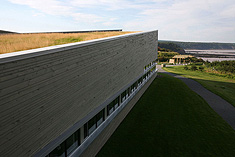
- The rainwater harvesting system collects rainfall from a roof area of 1,012 sq.m, with an assumed collector efficiency of 75%, resulting in an estimated total volume of collected water of 695,168 L). Based on full-time occupancy, the rainwater collector system would provide 100% of the water consumption (117,936 L) for the toilets.
- Use of native and drought tolerant vegetation eliminates the need for potable water irrigation.
- The green roof retards rainwater runoff on a site with limited capacity to absorb surface water.
- Pre-development, impervious area was 9900 m2, which was reduced to 9200 m2 post-development. This reduction was accomplished through topsoil placement, hydroseeding and the roof water cistern
- An engineered stormwater retention pond ensured no increase in the rate of stormwater runoff
- Best Management Practices as per EPA’s Guidance Specifying Management Measures for Sources of Non-Point Pollution in Coastal Waters (EPA 840-B-92-002 1/93) were implemented, which resulted in post development deductions of 80% in total suspended solids and 50% in total phosphorus.
|
|
|
Other Features & Measures |
 |
| PHOTO: WHW/Craig Mosher |
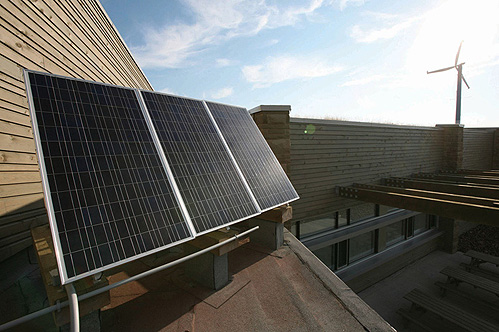
Solar energy and wind energy, the renewable energy sources used at this facility, are estimated to supply some 56% of the building’s total energy use.
- Twelve 175 W solar panels and one inverter generate 2,443kWh of electricity annually. The inverter is rated 3.3 kW.
- Wind energy is harvested using a Nova Scotia-made AOC 15/20 wind turbine with a fibreglass rotor and an induction generator that produces AC electrical power, meeting approximately 72,000 kWh of the annual electricity usage.
The wind energy potential was calculated using meteorological data collected on site and Natural Resources Canada’s software. NSWEP Wind Energy Research installed three anemometers, one wind vane, one temperature sensor, and one data logger. Data was collected for a twelve month period and a wind resource assessment conducted. NRCan used the average monthly wind speed for the twelve month period to calculate the turbine generator’s output. Their software compared the building’s hourly electric power consumption with the turbine generator’s hourly electric power production.
The facility participates in Nova Scotia Power’s Net Metering Program. In order to reduce system complexity, space and maintenance costs, battery storage was not included in the system design.
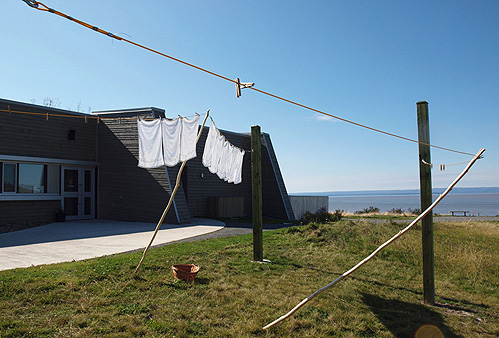
Green Housekeeping and operations practices include the use of only third-party certified products for cleaning and landscaping, washable towels in staff room (washed and air dried on site), an un-powered, reel-type lawnmower to maintain the small lawn, and bicycles for staff travel over the extended site. |
 |
| PHOTO: WHW/John Crace |
|
|
|
|

