OVERVIEW

ENERGY EFFICIENCY

OTHER SUSTAINABILITY FEATURES & MEASURES

DRAWINGS

MORE CASE STUDIES

ABOUT THE 2030 CHALLENGE


Building Type:
Interpretive Centre

Owner:
Cumberland Regional Economic Development Association / Joggins Fossil Institute Association

Location:
Joggins, Cumberland County, Nova Scotia

Budget:
$5,200,000 (1,235m2)

Completion: May 2008

PROJECT TEAM

Architect:

WHW Architects Inc.

John Crace, LEED AP
Partner in Charge/LEED Consultant

Ron Burdock, LEED AP Design/Project Architect

Project Staff:
David Phillips, LEED AP
Ian Miller
Karon Coffin, LEED AP
Lisa Tondino , LEED AP
Jonathan Carmichael

Brian Colgan, LEED AP
Construction Administration

Christine Bales, LEED AP
Sustainable Projects Coordinator

Interpretive Design:

Design + Communication

Landscape:

Vollick McKee Petersmann,
Cary Vollick

Structural:

BMR Structural Engineering,
Roy McBride

Electrical & Mechanical:

O’Neill Scriven & Associates,
Allan MacDonald & Trent Moore

Civil:

ABL Environmental,
Tom Austin

Environmental:

Strum Environmental,
Sean Cassidy

Archaeological Survey:

Davis Archaeological Consultants

Business Plan:

A. L. Arbic Consulting

Cost:

Hanscomb Limited

Fundamental Commissioning:

O’Neill Scriven & Associates, Peter Scriven (not part of Project Design Team)

General Contractor:

Pomerleau

Joggins Fossil Centre

WHW Architects Inc.

OVERVIEW

The Joggins Fossil Centre was designed to be a gateway to UNESCO World Heritage site Joggins Fossil Cliffs. The design of the centre was strongly informed by the natural and cultural history of these cliffs, which contain some of the world’s best fossil records of 300,000,000-year-old Coal Age (Carboniferous) life. They also contain once-abundant coal seams that were exploited by the Mi’kmaq, Acadian and Scottish inhabitants of the area for centuries. The client and the design team worked to design an interpretive centre for this “Coal Age Galapagos” that would represent a change in the way we view the use of fossil fuels.

As steward of this site of “universal value”, the client was acutely aware of the need to respect their own fossil resource and, by extension, the resources of the planet. An Energy Use Intensity of only 65% of the MNECB model building expresses the value “fossils are precious; we don’t burn them here.” The building’s reduced energy use is also entirely practical. While it was built with government assistance, the long-term survival of the centre requires low operating costs. Part of this is achieved through on-site renewable sources, which provide 56% of the total energy use of the building.

Just as integral to the project ethos as energy conservation is the use of local and recycled materials. In recognition of the Coal-age cycle of life and death, 19.9% of the building’s construction materials were from recycled sources and 22.8% were harvested and manufactured locally. The vegetated roof moderates stormwater flow and extends the lifespan of the roofing membrane. It also makes reference to the cliff-top topography of the building site.
 

Energy Conservation Features


Other Sustainability Features


Drawings

 
62% MEASURED
REDUCTION IN
ENERGY USE
National Average Energy Use
Intensity (EUI):
1,892 MJ/m2 (525 ekWh/m2)
Building's EUI:
716.5 MJ/m2
(199 ekWh/m2)
  Renewable Energy sources
The sun and the wind provide up to 56% of the centre’s energy needs through photovoltaic panels and a wind turbine.
[ CLICK FOR details ]
 
  Site integration
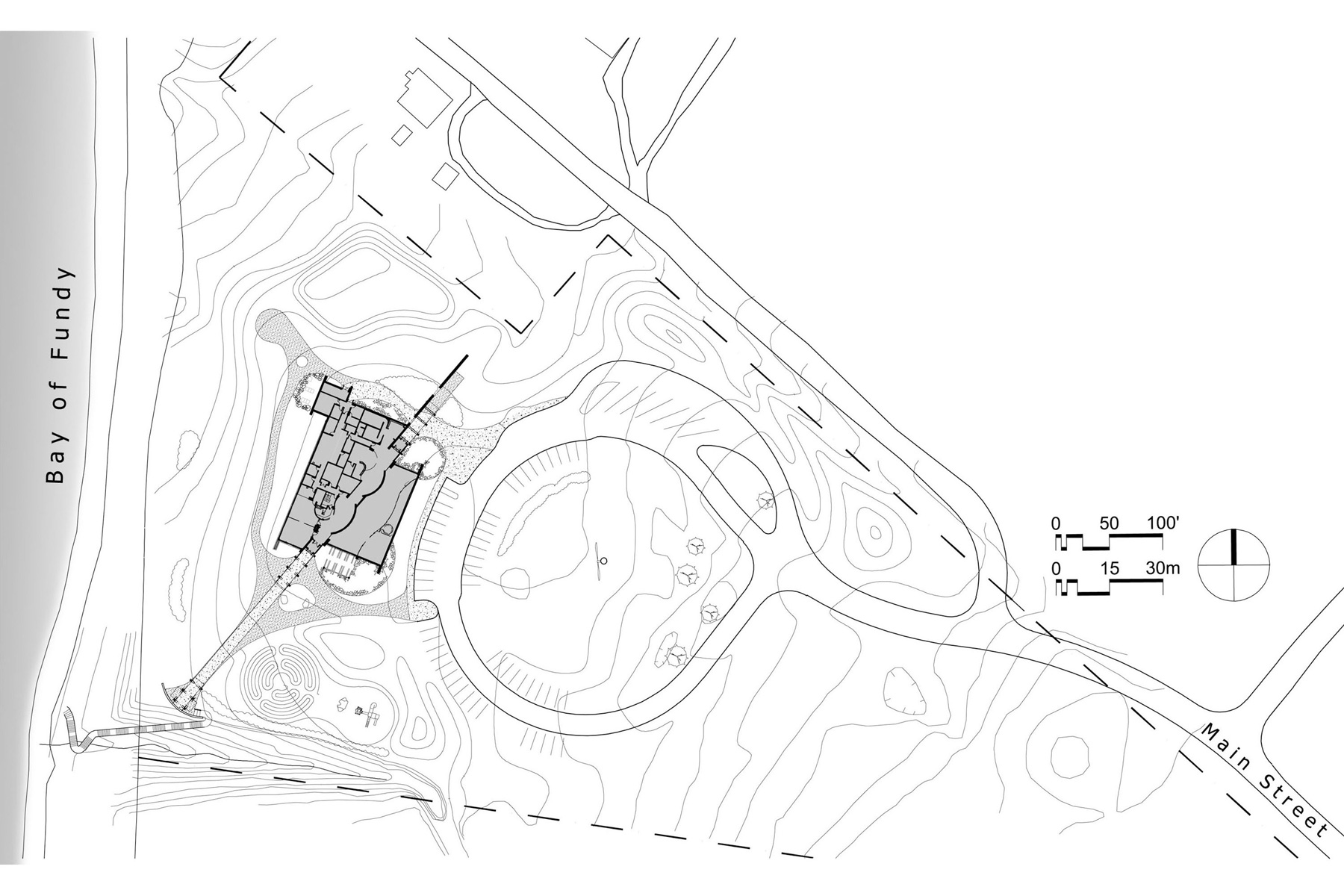
The largest building in the village, the centre is distinct but its form and materials ensure that it reflects its surroundings rather than dominates them.
[ CLICK FOR a drawing ]
 
  Low light pollution
Design of the lighting system ensures that the minimum of direct artificial illumination escapes through the windows.
[ CLICK FOR Solar Shading, Daylight & Lighting ]
 
  WATER CONSERVATION
The green roof retards rainwater runoff on a site with limited capacity to absorb surface water. A cistern stores a portion of the roof rainwater for non-potable use.
[ CLICK FOR DETAILS ]
 
  Building Envelope
Nova Scotia harvested hemlock siding provides a lightweight and durable cladding to much of the building. Applied parallel to the roof, the shadow lines in the boards recall the rock layers in the cliff.
[ CLICK FOR DETAILS ]
 
  WATER CONSERVATION
Water for non-potable uses is drawn from nearby ponds further reducing use of potable city water.
[ CLICK FOR DETAILS ]
 
Annual Energy Consumption – Energy Use Intensity (EUI)


Energy Sources for Building’s Energy Use

Renewable energy harvested on-site through solar panels and wind turbine