OVERVIEW

ENERGY EFFICIENCY

OTHER SUSTAINABILITY FEATURES & MEASURES

DRAWINGS

MORE CASE STUDIES

ABOUT THE 2030 CHALLENGE


Building Type:
Educational Services

Owner:
École Polytechnique de Montréal

Location:
Montreal, Quebec

Budget: $90,000,000

Completion: Summer 2005

PROJECT TEAM

Architect:

Saia Barbarese architectes (now Saia Barbarese Topouzanov architectes)

Designer: Mario Saia

Assistant Designer:
Vladimir Topozanov

 
Desnoyers Mercure et associés

Project Manager:
André J.Mercure

 
Menkès Shooner Dagenais Architectes (now Menkès Shooner Dagenais LeTourneux Architectes)

Project Manager:
Anik Shooner
(responsible for LEED component and coordination of electromechanical systems integration, site supervision)

Mechanical Engineer:

Bouthillette Parizeau et associés inc.

Electrical Engineer:

Pageau Morel et associés inc.

Building Structure:

Pasquin St-Jean et associés experts-conseils

Construction Management:

Le Groupe Axor inc.

Landscaping Consultant:

Williams Asselin Ackaoui et associés

LEED Support:

Lyse M. Tremblay architecte

Vertical Transportation Consultant:

Exim

Kitchen Design Consultant:

Bernard et associés

AV Equipment and Multimedia Systems Consultant:

Go Multimedia (classrooms, training rooms, laboratory)

Pavillons Lassonde, École Polytechnique de Montréal

Saia Barbarese architectes
Desnoyers Mercure et associés
Menkès Shooner Dagenais Architectes

ENERGY EFFICIENCY


Heating, Cooling & Ventilation

PHOTOS: Alain Laforest
  • The mechanical components of the buildings are not visible on the roofs but integrated into the architecture.
  • Compared to natural gas heating, heating by means of direct-contact water heaters in the Lassonde buildings results in a GHG reduction of 580 tonnes of CO2.
  • A system is installed to recover heat from the boilers of the main building of L’École Polytechnique, and supplies about two-thirds of the buildings’ energy requirements.
  • The combustion product of the three steam generators, totalling 54,600,000 BTU/h, is sent to the direct-contact heat recovery system. With this equipment, it is possible to heat water to 138°F and achieve an efficiency level of up to 98% of the heat produced. Low temperature heating of the Lassonde buildings (105°F) therefore incorporates the recovered heat into the system.
  • When insufficient heat is recovered from the flues of the main building to meet the demand of the new structure, the heat rejection from chilled water production makes up the shortfall.
  • Other measures used include calibrating fresh air intake based on the quantities of CO2 measured using sensors, preheating the fresh air supply from the stale air exhausters, and managing temperatures based on data from presence detectors.


Building Envelope

PHOTO: Marc Cramer
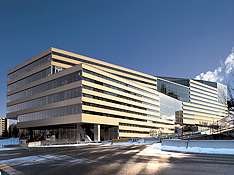
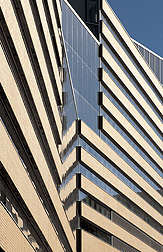
  • The dynamic lines of the overall space are enhanced by the composition of the principal materials used in the façades – glass and brick.
  • Some of the roof has been planted as a garden (800 m2), which plays a not-negligible insulating role.
  • A new process has been used for the non-vegetative areas of the roof: the impermeable roofing membrane has been covered in highly reflective white gravel, which reflects heat from the building (heat island), especially in summer, thereby reducing the need for air-conditioning.
  • Calibration of the windows is directly related to sun exposure and the reduced need for air-conditioning. To limit the heat from solar radiation, windows with a northern exposure are large, while exposure on the south side is limited. Windows with eastern and western exposures are also smaller for the same reasons.

Solar Shading, Daylight & Lighting

PHOTOs: left - Vladimir Topouzanov / right - Marc Cramer
  • The brick façades act as “Venetian blinds”.
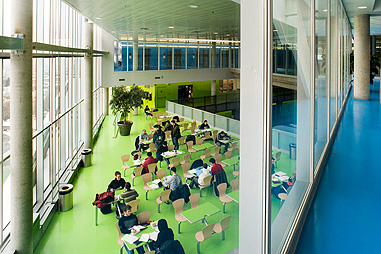
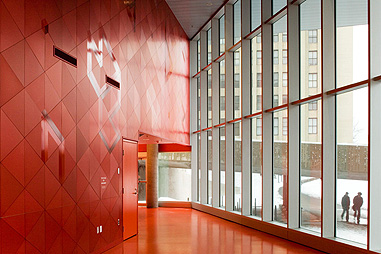
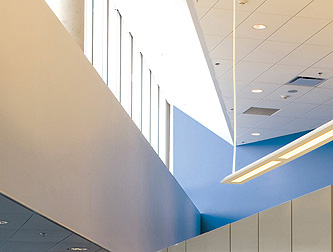
  • Despite the limited presence of windows on the south, east and west sides, the seven-storey building is distinct for its well-lit interior owing the light which floods into the atrium via two large light wells.
  • Artificial lighting is triggered by presence detectors.