OVERVIEW

ENERGY EFFICIENCY

OTHER SUSTAINABILITY FEATURES & MEASURES

DRAWINGS

MORE CASE STUDIES

ABOUT THE 2030 CHALLENGE


Building Type:
Educational Services

Owner:
École Polytechnique de Montréal

Location:
Montreal, Quebec

Budget: $90,000,000

Completion: Summer 2005

PROJECT TEAM

Architect:

Saia Barbarese architectes (now Saia Barbarese Topouzanov architectes)

Designer: Mario Saia

Assistant Designer:
Vladimir Topozanov

 
Desnoyers Mercure et associés

Project Manager:
André J.Mercure

 
Menkès Shooner Dagenais Architectes (now Menkès Shooner Dagenais LeTourneux Architectes)

Project Manager:
Anik Shooner
(responsible for LEED component and coordination of electromechanical systems integration, site supervision)

Mechanical Engineer:

Bouthillette Parizeau et associés inc.

Electrical Engineer:

Pageau Morel et associés inc.

Building Structure:

Pasquin St-Jean et associés experts-conseils

Construction Management:

Le Groupe Axor inc.

Landscaping Consultant:

Williams Asselin Ackaoui et associés

LEED Support:

Lyse M. Tremblay architecte

Vertical Transportation Consultant:

Exim

Kitchen Design Consultant:

Bernard et associés

AV Equipment and Multimedia Systems Consultant:

Go Multimedia (classrooms, training rooms, laboratory)

Pavillons Lassonde, École Polytechnique de Montréal

Saia Barbarese architectes
Desnoyers Mercure et associés
Menkès Shooner Dagenais Architectes

OTHER SUSTAINABILITY FEATURES & MEASURES


Products & Materials

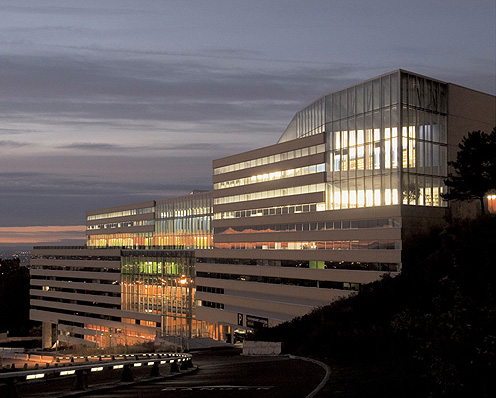
PHOTOs: left - Alain Laforest / right - Vladimir Topouzanov

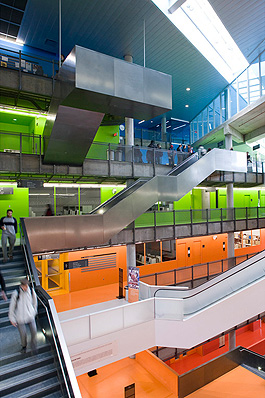
The project materials were judiciously selected to favour materials that have been recycled, are locally supplied or minimize the level of volatile organic compounds (VOCs) released during building construction and occupancy.

Of the materials used in the Lassonde buildings, 10.06% are from post-consumer recycled materials and 5.03% from post-industrial recycled materials, for a combined total, using LEED calculations, of 12.5%. According to the LEED evaluation grid, this structure earns two (2) points, the top score for this category.

The materials used to maximize energy efficiency are:

  • Agglomerated straw (rapidly renewable material)
  • Floors of 100% solids, water-based epoxy resin, for high traffic (wear-resistant)
  • Recoverable steel: studs of interior and exterior walls, reinforcements, support structure of ceilings, atrium stairways, window casings and interior doors
  • Recoverable acoustical tiles
  • “Green label” approved carpeting, containing a certain percentage of recycled materials
  • Steel used for balustrades and fastenings of 30% post-consumer materials and 70% post-industrial materials
  • Rebar of recycled steel, 100% from recycling
  • Structural steel, 60% from recycling


Water Conservation

Rainwater is used to maintain the roof garden (no artificial irrigation) or simply recovered by means of drains on the white gravel rooftop and held in a reservoir for future use within the building, notably in the sanitary water system, reducing drinking water consumption by 92%.

Other Features & Measures

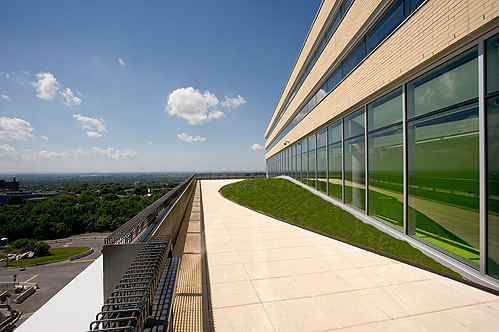
PHOTO: Alain Laforest

Some of the rooftop has been planted as a garden (800 m2) and affords an unobstructed view of the city. The vegetative area consists mainly of clover, which acts as an air purifier by drawing nitrogen from the air.

The terrace on level 6 of the structure is accessible to users and is an interesting combination of vegetation and paving slabs. The view from this terrace is impressive, and because of its situation and exposure, it is useable at least eight (8) months of the year.

LEED GOLD Certification
The Pavillons Lassonde are the first educational institution built in Quebec to receive LEED GOLD Certification, and have therefore become the benchmark for sustainable construction in Quebec.