|
 |
|
École Lawrence Grassi Middle School
GEC Architecture
ENERGY EFFICIENCY
|
Heating, Cooling & Ventilation |
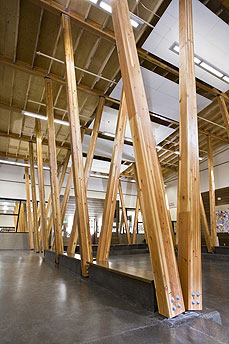 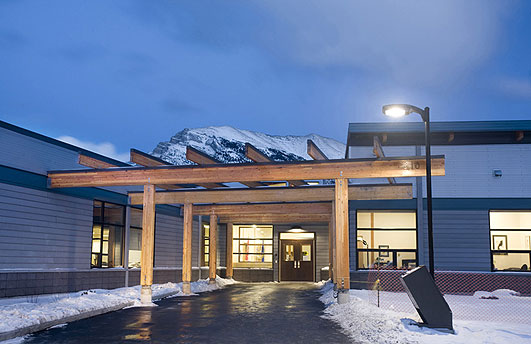 |
| PHOTOS: Steve Nagy Photography |
- The project has no active solar or other on-site renewable energy systems.However, through building envelope enhancements and by largely de-coupling ventilation and thermal control, the building was able to achieve significant reductions in energy use and greatly improved indoor air quality over more conventional systems.
- The vast majority of heating is provided by two, high efficiency, gas-fired, fully condensing boilers that circulate heated water through in-slab piping at the outer 2 m of concrete floor slab and at a temperature that is only slightly above the desired ambient room temperature.
- The school has no mechanical air conditioning system. On warmer school days (e.g. in late spring and early fall), piping in the non-perimeter slabs is used for radiative cooling.
- Canmore, like much of Alberta, experiences large day-night temperature swings throughout most of the year further aided by the town’s higher altitude (about 1350 m above sea level) and predominantly sunny skies. Using this cooler nighttime air, a coil in the main air handler is able to “free-cool” the building’s ventilation air and in-slab circulating water.
- By leveraging the floor slab’s large surface area and thermal mass, a further cooling effect is achieved.
- Other than in the gym-auditorium, a displacement ventilation system provides 100% outdoor air with reverse-flow heat recovery. Warm, stale air is displaced at low level by fresh incoming air and removed near the top of each room via ductwork connected to the heat recovery ventilators. The gym air handler is a variable flow type, providing maximum flow only for high cooling loads (e.g. during assemblies). A CO2 sensor adjusts outdoor air flow to occupant requirements
|
Building Envelope |
Exterior walls:
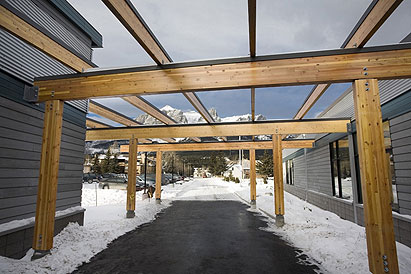
Pre-finished wood siding, burnished block veneer, or prefinished metal panels on strapping, building paper and plywood sheathing over a cavity-insulated 2 x 6 wood stud wall. The air/vapour barrier is located to the warm side of the insulated cavity between 2 interior layers of gypsum wall board.
- 2 layers building paper
- 10mm exterior gr. Plywood
- 38mm x 140mm wood studs @ 400mm o/c
- 140mm batt insulation R 3.5 (R 20)
- 13mm GWB
- Vapour barrier polyethylene
- 13mm GWB
|
 |
| PHOTO: Steve Nagy Photography |
|
Roof
RSI 6.1 (R 34.6):
Fully-adhered, 2-ply, SBS modified bitumen roof system over structural insulated panels affixed directly to the primary structure.
- Torch applied S.B.S. granular cap sheet roofing membrane
- 12mm mineral wool composite board c/w factory-applied S.B.S.
- Self-adhering S.B.S. roof membrane
- Structural Insulated Panels (sandwich of OSB and expanded polystyrene)
Windows:
High-quality, energy-efficient, aluminum-clad wood window systems with high-performance triple-pane glazing have the added benefit of lower capital cost premiums, longer or comparable life-span, and lower embodied energy numbers when compared to other readily available high-performance window assemblies.
Floor slab /Foundation:
The floor slab is used in conjunction with an in-slab “tempering” system utilizing the depth and areal extent of concrete for its thermal capacitance.
- Floor slab: 130mm cast-in-place concrete S.O.G.
- 38mm thick rigid insulation (RSI 1.3) installed beneath the slab, horizontally, 2400mm inside from slab edge
- Foundation: 200 mm thick CIP perimeter foundation wall on spread footings
- 50mm thick rigid insulation (RSI 1.76) applied to exterior face of wall to min. depth of 1200mm
|
Solar Shading, Daylight & Lighting |
 |
| PHOTO: Steve Nagy Photography |
|
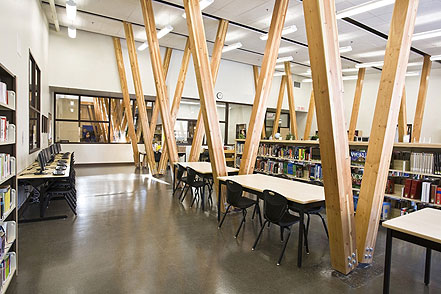
In spite of not qualifying for the LEED® daylight credit or utilizing day-light responsive electric lighting controls, and with only a handful of occupancy sensors, the school’s lighting power density was still 44% better than the MNECB reference. Siting and orientation of the school, with classroom wings, student gathering, and library all benefiting from a predominantly north-south alignment on the longer east-west axis, play an important role in terms of access to and control of daylight and solar gain respectively. Post-occupancy measurements suggested that lighting levels and power densities could be reduced and in select circulation spaces de-lamping and re-wiring of luminaires was undertaken by the school division with no noticeable impacts reported by the building occupants. |
|
|
|
|


