|
 |
|
Manitoba Hydro Place
Kuwabara Payne McKenna Blumberg Architects
Smith Carter Architects and Engineers
Prairie Architects
ENERGY EFFICIENCY
|
Heating, Cooling & Ventilation |
  |
| PHOTOS: TOM ARBAN |
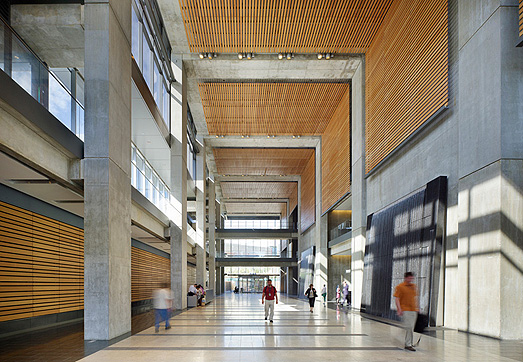
Manitoba Hydro Place is an exemplar of climate responsive, energy efficient design for large buildings in extreme climates. Since the first occupants moved into the building in December 2009, the building has exceeded the original 60% goal and is now targeting 66% energy savings. This is in large part due to the Integrated Design Process, which ensured the rigorous integration of systems and operations. Climate-responsive features in the design take advantage of Winnipeg’s unusual abundance of sunshine and dominant gusting south winds to harness passive solar and wind energies.
- A sophisticated building management system monitors internal and external environments to optimize lighting, solar shading, and heating/cooling loads while optimizing passive energy resources
- The high performance building envelope includes a radiant slab between the double facades on the west and east sides of the building. This maintains minimum temperatures in winter.
- Radiant heating and cooling is also delivered through an exposed concrete thermal mass, moderating extreme temperature swings and allowing maximum passive solar gains in winter and natural ventilation in the shoulder and summer seasons.
- In the summer, the radiant slab in the façade exchanges heat with the geothermal field (280 boreholes, 125 metres deep).
- Three south-facing, six-storey high 'wintergardens' act as lungs, with 24 metre tall ‘waterfalls’ that humidify/dehumidify air entering the building.
- Ventilation is partly mediated through the Solar Chimney. During shoulder seasons, the windows open, drawing in air passively. In the winter, the chimney draws exhaust air down to heat the parkade and pre-heat incoming cold air via the south atria. During warmer seasons, the solar chimney acts to exhaust stale air from the building.
- Low pressure, raised floor displacement air delivery allows for individual environmental control at each workstation. 100% of the office space can also be ventilated or cooled with operable windows.
- Carbon neutral power is provided by Manitoba Hydro’s clean energy, hydro and wind electric sources.
|
Building Envelope |
 |
| PHOTO: Gerry Kopelow |
Building Envelope 1 (West and East Walls):
- Biodynamic double facade creates a high performance envelope and reduces heating/cooling loads by providing a tempered buffer to extreme outdoor temperatures.
- Operable windows on the inner and outer walls of the double facade permit natural ventilation at seasonally appropriate times of the year.
Building Envelope 2:
- High performance Single Wall
Building Envelope for North and South Atria:
- Paired assemblies - an enlarged double wall cavity acts as the towers’ preconditioning space.
- The Solar Chimney cladding is present both externally and internally, concealing a thick layer of mineral fiber insulation. A high performance insulated panel system is combined with a simple single glazed unitized system.
Windows:
- At Grade: triple glazed retail façade
- Connection between tower and podium: fritted clerestory glazing with two levels of performance
- Beneath East tower: High performance triple glazed assembly
- Beneath West tower: basic double glazed IGU assembly
|
|
|
Solar Shading, Daylight & Lighting |
 |
| PHOTO: Eduard Hueber |
Daylighting:
- Total building area that is daylit: 85%
- The advanced façade system ensures maximum daylight. Automated louvers and windows open and close in reaction to light and temperature changes. The city can see the bioclimatic design in action.
- East and west tower facades are double glazed with motorized windows on the exterior and single glazed on the interior with manually operated hopper style windows.
- Large format automated, perforated louver blinds within the double façade open and close over the course of the day to minimize excessive solar gains and glare. Louvre blades at the top act as a light shelf, bouncing additional light onto the white radiant ceiling.
- Narrow, 11.5 metre wide office lofts ensure access to views and natural light
Artificial Lighting:
- Direct/indirect T5 HO fixtures are dimmable, equipped with day-lighting and occupancy sensors, and are individually addressable from the central BMS to allow daylight harvesting for maximum efficiency and flexibility.
- Slightly lower overhead lighting levels reduce potential glare. Individual LED task lights at each workstation focus light on the work surface.
- User control of lighting in the offices, managed through their desktop computers will save a projected additional 10-15% in electrical lighting loads through the simple act of enabling individual environmental control.
- All of the office space can be ventilated or cooled with operable windows.
Beyond energy conservation, the goals to provide 100% fresh air and maximum daylight reflect the owner’s commitment to the health and well-being of its greatest asset – its employees. |
|
|
|
|


