|
|
 |
|
| |
Building Type:
Industrial
Owner:
The Stageline Group
Location:
L'Assomption, Quebec
Budget: $5,100,000
Completion: January 2009
PROJECT TEAM
Architect:
Allard, Hamelin Lalonde, Consortium d'architectes:
Claude Hamelin Lalonde
Luc M. Allard
Jean-François Charbonneau
Pierre Durand
Christian Masse
LEED Accredited Professional:
Luc M. Allard, Architecte:
Jean-François Charbonneau
Structure:
Murox, a division of Canam:
Martin Couture
Mechanical - Electrical:
MuroxEnergy, a division of Canam:
Dany Baillargeon
Jean-Philippe Monfet
Michel Pettigrew
Breton, Banville et Associés S.E.N.C.:
Christophe Desage
Louis-François Gagnon
Marie-Josée Audet
Civil Engineering:
Aubé, Gareau Ingénieurs Conseils:
Jean-Marie Audet
Lighting Consultant:
NRG Management Inc.:
Allain Durette |
|
|
|
|
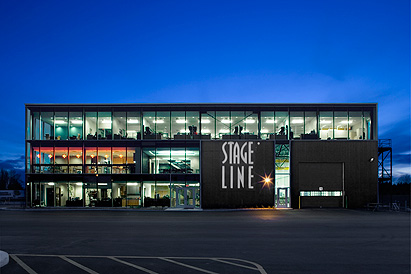
The Stageline Group Building
Allard, Hamelin Lalonde, Consortium d'architectes
ENERGY EFFICIENCY
|
Heating, Cooling & Ventilation |
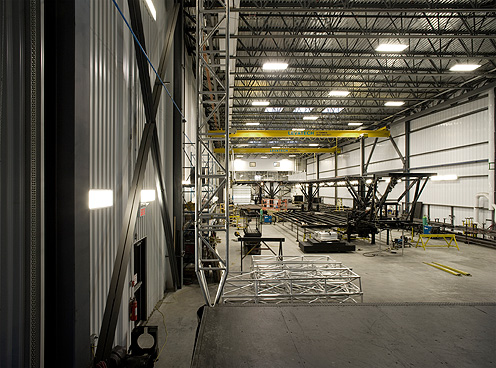  |
- The primary energy source for the building is the electric chiller, which serves as a geothermal heat pump, and is connected to 20 closed-loop wells at a depth of 150 metres;
- The UV-3 Regent ECO heat recovery system (7,200 CFM), installed on one of the ventilation systems, allows savings of about 80% in summer and 90% in winter;
- Three rotary heat exchangers heat the fresh air supply in the administrative area (3,900 CFM), the maintenance area of Leasing Services (7,800 CFM), and the assembly and set-up area (3,200 CFM);
- A 320-ft.2 thermal solar wall works with the rotary heat exchanger for the maintenance area. Fresh air is drawn into a cavity between the solar wall and the exterior metal cladding. The dark metal cladding warms this air, which is then released into the building. The annual renewable energy output from the passive solar wall is 230.4 million BTUs and results in temperature gains of up to 20°C and yearly of 66.7 MW-h;
- The building is also equipped with radiant floors to increase the comfort of the occupants and the thermal inertia of the building.
|
Building Envelope |
|
Roof:
- Thermoplastic polyolefin membrane, white finish
- 2 wood-fiber panels, 12.5 mm
- Rigid expanded polystyrene insulation, 115 mm, type 2 (R-value=4.2)
- Vapour barrier
- Gypsum plasterboard, 12.5 mm
- Plywood, 13 mm, 400 mm width, along entire perimeter and around baseframes and drains
- Metal bridging, 115 mm
- Steel structure by Murox
- Ceiling finish
Prefabricated walls (MuroxEnergy system):
- Exterior cladding, M-156-R, 26 Ga, Galvalume Plus finish
- Polyisocyanurate, 1”x2”, covered in a Sopraseal 1100 membrane, 50 mm
- G girts 5"x2"x16 Ga with insulation
- Fibreglass insulation, 150 mm (R-value=3.52)
- Vapour barrier
- Interior cladding, M-156-R, 26 Ga, 8000 series, White White QC8317
|
|
Windows and enclosure walls:
(low-emissivity glazing to conserve heat and reduce infrared radiation)
- Aluminum profiles nos. 3406, 3404, 3436, 3411, 3445 and 3446 with structural joint system
- At all floor levels, a pressure plate and cover no. 3413 installed on the interior side to close the space between the enclosure wall and the concrete slab
- Mullions, 65 mm wide by 145 mm and 100 mm deep, as shown on the plans, and mullions composed of several elements with fish plates
- Pressure plates
- Thermal break, semi-rigid vinyl
- Aluminum cover, 1.6 mm thick
- Extruded aluminum moldings screwed onto the cover
- Galvanized structural steel bracing to rigidify the mullions
- Anchor sleeves and expansion joints nos. 346-a and 344-a
- Special extruded aluminum profiles with structural bracing
- Sealed double-glaze insulating glass units compliant with standard CAN/CGSB 12.8, consisting of an outer Solexia pane, heat-strengthened, 6 mm thick
- Space, 12.5 mm, filled with Argon gas, with low-conductivity Thermal Edge spacer, black, with folded corners, filled with desiccant on both sides
- Clear inner pane, 6 mm thick, with low-emissivity Solarban 60 coating in position 3, to form an insulating glass unit with a total thickness of 25.4 mm
Foundation walls:
- Concrete wall, 200 mm
- Rigid insulation, 50 mm (R-value=1.75)
|
|
Solar Shading, Daylight & Lighting |
| |
 |
| |
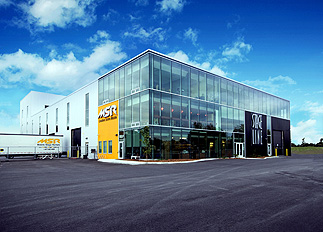
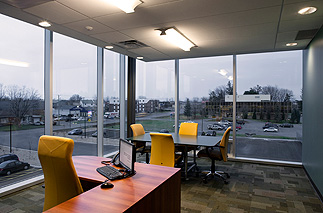
PHOTOs: Stageline (top) / Marc Cramer (bottoM): |
- The main façade, virtually a wall of glass, allows natural light to penetrate deep into the interior of the building. Glare is reduced by north-east and south-east orientation.
- Light wells direct light to work areas and white interior cladding of the walls helps reflect light.
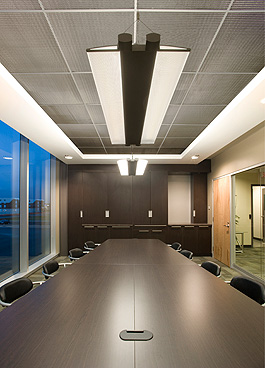
- Efficient lighting fixtures are used: T5 fluorescent lamps, compact fluorescent lamps, and metal halide lamps.
- Occupancy detectors and natural light detectors are major components of the building’s smart lighting control system.
- The building’s lighting power density is 9.56 W/m2, versus 32.30 W/m2 for the reference building.
- Exterior lighting is angled to reduce light pollution, and is controlled by a photoelectric cell set to the astronomical timetable.
|
|
|
|